Skip to content

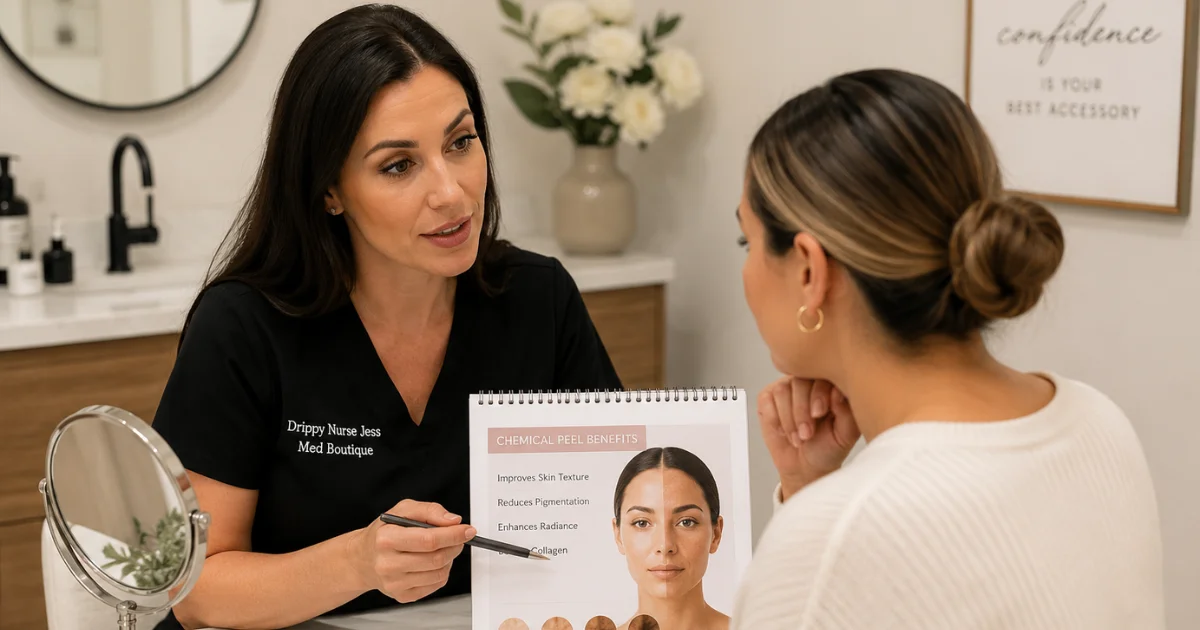
If you have been looking in the mirror at rough patches, dullness, or stubborn dark spots that just will not budge, you are not alone, and you are not stuck with them. At Drippy Nurse Jess Med Boutique, we help you learn more about how chemical peel benefits improve your skin texture and tone.
Why Does a Chemical Peel Improve Skin Texture and Pigmentation?
A chemical peel exfoliates the skin’s outer layers, lifting away dull, damaged cells and those holding excess melanin. This smooths rough texture and fades discoloration, while the controlled process prompts fresh collagen and newer, more even-toned skin to surface underneath.
What a Chemical Peel Actually Does to Your Skin
A chemical peel is a solution of one or more acids applied to the skin to exfoliate the outer layers in a controlled, deliberate way. That word “controlled” matters. This is not skin damage in the way it sounds. It is a measured exfoliating facial treatment that removes the tired, built-up cells sitting on the surface so the healthier skin underneath can take their place.
Different acids do this at slightly different depths. Glycolic acid is small and penetrates quickly, making it a workhorse for texture and brightness. Salicylic acid loves oily, congested skin and gets into pores. Lactic acid is gentler and more hydrating, which suits sensitive skin.
TCA reaches deeper for more significant resurfacing. As those old cells loosen and lift away, what remains is smoother to the touch and more even in tone. That single mechanism is the foundation for nearly all of the chemical peel benefits people notice.
How Peels Smooth and Refine Skin Texture
Facial peels in Gilroy, CA, improve texture by dissolving the glue that holds dull, dead cells onto the surface of your skin. Think of how skin can feel rough, flaky, or just a little lackluster no matter how much you moisturize.
A lot of that comes from a layer of cells that should have shed but did not. When the acid breaks those bonds, the buildup sheds as it should, and your skin immediately feels softer and looks brighter.
Once that surface clears, a few things tend to improve together:
- Fine lines look softer because the skin reflects light more evenly.
- Pores can appear smaller once the debris around them is cleared.
- The overall surface feels smoother & more refined.
There is a second, slower benefit too. The controlled exfoliation signals your skin to produce fresh collagen in the weeks that follow.
Collagen is the support structure that keeps skin firm and resilient, so over time, a series of peels can refine texture in ways that go deeper than surface smoothing alone. This is why a good glow skin peel often looks even better a few weeks out than it does the day after.
How Peels Fade Pigmentation and Even Skin Tone
Pigmentation responds to peels because much of that unwanted color lives in the upper layers of skin. When a peel exfoliates those layers, it physically removes cells loaded with excess melanin, the pigment responsible for dark spots & patches.
On top of that, certain acids can quiet overactive melanin production, so the skin makes less new discoloration as it heals. That makes peels a genuinely useful hyperpigmentation treatment for several common concerns:
- Sun spots from years of accumulated light exposure
- Post-acne marks, known clinically as post-inflammatory hyperpigmentation, are the discoloration a breakout leaves behind after it heals.
- Some cases of melasma, the hormonal patchiness that often shows up on the cheeks and forehead
Here is the honest part. Results vary quite a bit based on the type of pigment. Surface-level discoloration, such as sun spots and post-acne marks, usually responds more quickly and visibly.
Melasma is deeper & more stubborn, often tied to hormones, & it tends to require a careful, gradual approach rather than a single aggressive treatment. A peel can minimize & soften it, but managing melasma is usually an ongoing process rather than a one-and-done fix.
The Different Types of Peels and What Each One Targets
Not all peels are the same, and that is a good thing because it means the treatment can be matched to your specific skin and concern. Generally, they fall along a depth spectrum. Superficial peels use milder acids, such as lactic or low-strength glycolic acid.
They are excellent for addressing texture, dullness, & light discoloration, and they come with little to no downtime, making them an easy entry point. Medium-depth peels reach deeper into the skin to address more stubborn pigment and rougher texture, and they require a bit more recovery time in exchange for more noticeable change.
Why a Provider’s Assessment Matters for Texture and Pigment
The right peel can transform your skin, and the wrong one can set it back, which is why a professional assessment matters so much, especially with pigmentation. Some peels are not suited to deeper skin tones, & an ill-matched strength can actually trigger more discoloration instead of fading it.
That is the opposite of what anyone wants. Our provider at Drippy Nurse Jess Med Boutique considers your skin type, history of discoloration, and goals before making any recommendations. Professional treatments are also controlled in a way that store-bought products simply are not.
The concentration, timing, and neutralization are all managed for you, which is a big part of why in-office results tend to be more reliable and more consistent. If you are considering skin rejuvenation in Gilroy, CA, that conversation is the real starting point.
Common Questions About Chemical Peels, Texture, and Pigmentation
Do peels work on all skin tones?
Yes, when the peel is chosen correctly for your skin. The key is matching the acid and depth to your Fitzpatrick skin type, which is exactly why a provider’s input matters before any facial peel appointment in Gilroy, CA.
Can a peel fully remove pigmentation?
A peel reduces and evens pigmentation rather than erasing it permanently. Results vary by pigment type, and ongoing sun protection plus occasional maintenance treatments help keep your tone clear over time.
Is one peel enough, or do I need a series?
It depends on your concern. Surface texture and mild dullness can improve after a single peel, while deeper pigment usually responds best to a planned series spaced out over several weeks.
Glow Up Your Skin
At Drippy Nurse Jess Med Boutique, we tailor every skin resurfacing treatment to your skin, your tone, and your goals, so your results feel like the best version of you. If you are ready to explore chemical peels in Gilroy, CA, our team is here to guide you with care. Book Your Skin Rejuvenation Peel Today!